
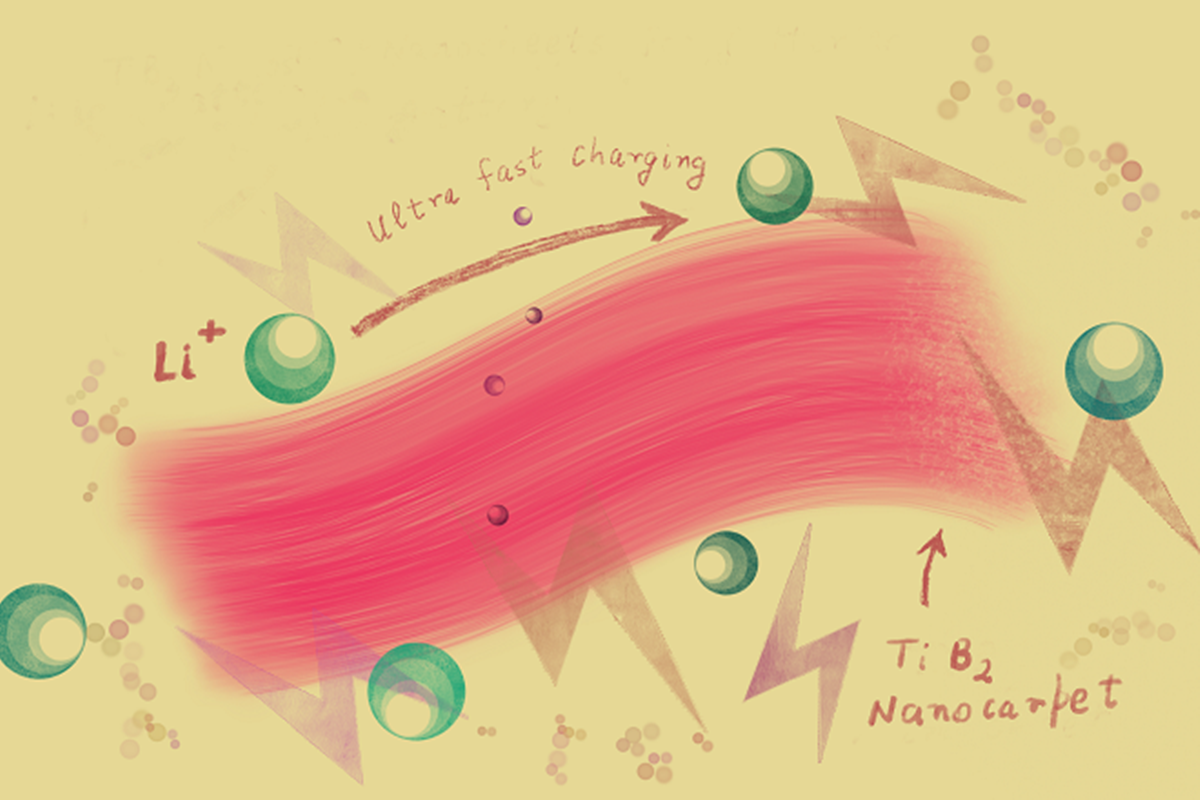
Key features of the new anode material invented for Li-Ion batteries

● Ultra-fast charging time (full charge within minutes)
● Long life cycle (10,000 cycles at high charge currents)
● Based on a new class of nanosheets (discovered by Indian scientists) that combine the rich chemistry of Titanium and Boron.
This transformational research innovation for various battery-based gadgets has a rich potential for translation from lab to real-life application
Gandhinagar: You will soon be able to charge your battery-based gadgets or even electric vehicles at ultra-fast speed as a team of researchers from the Indian Institute of Technology Gandhinagar (IITGN), in collaboration with the Japan Advanced Institute of Science and Technology (JAIST), has invented a new anode material* that enables lithium-ion batteries (LIBs) to be recharged within minutes. The new two-dimensional (2D) anode material has been developed using nanosheets derived from Titanium Diboride (TiB2), a material that resembles a multi-stacked sandwich, where metal atoms are present in-between layers of Boron. This transformational research innovation has a rich potential for translation from lab to real-life application.
Existing battery materials and their limitations:
Currently, Graphite and Lithium Titanate are among the most widely used anode materials in the commercially available lithium-ion batteries (LIBs) that power laptops, mobile phones, and electric vehicles. LIBs with Graphite anode, which is extremely energy dense, can power an electric vehicle for hundreds of kilometres in one charge cycle. However, it has its own share of challenges on the safety front as they are prone to fire hazards. Lithium Titanate anodes are safer and more preferred alternatives, and they also facilitate fast charging. But, they have a lower energy density, which means that they would need more frequent recharging.
What key features give Li-Ion batteries enabled by nanosheets based anode material an edge:
● Ultra-fast charging time (full charge within minutes)
● Long life cycle (10,000 cycles at high charge currents)
● The nanosheets that are used to prepare anode have a high density of pores. While the planar nature and chemistry of nanosheets provide a high surface area for catching hold of Li ions , the pores enable a better diffusion of ions The research teams at IITGN and JAIST aimed to develop a material for anode that not only enables fast charging of the battery but should also facilitate a long life. The team also had another important consideration that the material should be such that it can be synthesised in a simple scalable way so that it can transform existing technology.
The research team led by Prof Kabeer Jasuja (from IITGN) and Prof Noriyoshi Matsumi (JAIST) found that when Titanium Diboride (TiB 2 )-based Hierarchical Nanosheets (THNS) were used to prepare the anode, it exhibited a discharge capacity of 174 mA h/g (a unit that measures the energy capacity of a battery) that can be obtained at a current rate of 1 A/g within 10 minutes.
The intertwined carpet-like structure facilitates an efficient migration of charges in and out of nanosheets with ease, which resolves a Lithium-Ion diffusion-related challenge. They also found that this anode had an ultra-fast charging capacity with a considerable discharge capacity at high-capacity retention (up to 80% even after 10,000 cycles of operation), which means that batteries made with this material would give almost the same high performance even after more than 10,000 cycles of charging.
Moreover, there was no degradation or corrosion of THNS due to redox reactions, the porosity is also retained very well, and it demonstrates structural stability with very less volumetric expansion (less than 40%) over thousands of charge−discharge cycles.
Explaining the high efficiency of the newly innovated battery material, Akash Varma, an MTech student, who is also the first author of this work, says, “It is the presence of titanium and boron atoms arranged in a carpet-like interweaved porous structure within the nanosheets that are helping in an efficient charge transport and storage.” He spent one year at IITGN and another year at JAIST as a part of his double master’s degree – a unique collaborative programme between JAIST and IITGN.
Efficient solid-state diffusion of Li-Ions, nature of the electrode−electrolyte interface, electrode porosity, and accessibility to the active sites are crucial factors instrumental in attaining faster and high-rate kinetics inside the battery. The team states that the pores within Titanium Diboride (TiB 2 )-based Hierarchical Nanosheets act as channels for fast and reversible ion transport; hence, Lithium-Ions can be rapidly inserted and extracted from the nanosheets resulting in faster charging capacity.
Future of high-capacity battery materials:
The researchers emphasised that this is a promising technology for commercial applications where high energy density, high power, long life, and ultra-fast charging are desired. The research team plans to translate this work from the lab to a real-life application.
Prof Kabeer Jasuja, Dr Dinesh O Shah Chair Associate Professor of Chemical Engineering, IITGN, says, “What makes this work especially useful is the fact that the method to synthesise TiB 2 nanosheets is inherently scalable. It only requires mixing the TiB 2 particles in an aqueous solution of dilute hydrogen peroxide and allowing it to recrystallise. For any nanomaterial to translate into a tangible technology, scalability is the limiting factor. Our method to synthesise these TiB 2 nanosheets only requires stirring and no sophisticated equipment, making it highly adoptable.”
Throwing more light on the need for this innovation, Prof Noriyoshi Matsumi, Professor of Materials Chemistry, JAIST, says, “Nowadays, the requirement for high-rate charge-discharge technology is tremendously increasing in order to enable widespread commercialisation of various kinds of electric vehicles in future. Our findings can stimulate related research fields to invite more researchers to work on application of the unique 2D materials. We hope continuous research will contribute to the convenience of EV users, lesser air pollution on the road, especially in cities, and less stressful mobile life, which will enhance the productivity of society.”