
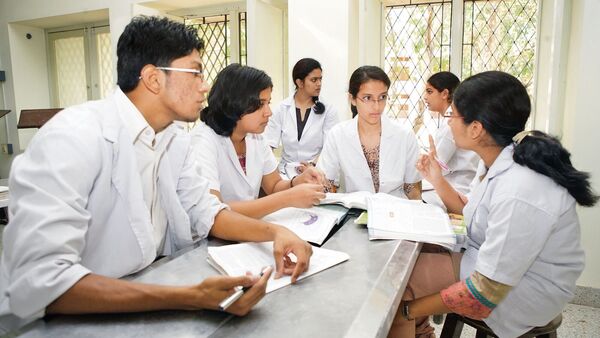
The Union Cabinet, chaired by Prime Minister Narendra Modi, has approved a major expansion of medical education in India, adding 10,023 new undergraduate (MBBS) and postgraduate (PG) seats in government medical institutions.

Under Phase-III of the Centrally Sponsored Scheme (CSS), 5,000 new PG seats will be created in government medical colleges, standalone PG institutes, and hospitals. Another 5,023 MBBS seats will be added by upgrading existing government medical colleges, with the cost per seat increased to ₹1.50 crore.
The total budget for these schemes from 2025-26 to 2028-29 is ₹15,034.50 crore, with ₹10,303.20 crore from the central government and ₹4,731.30 crore from state governments.
Benefits:
- More students will have access to medical education in India.
- Improved quality of medical training to meet global standards.
- Better availability of doctors and specialists across the country.
- Enhanced healthcare access in rural and remote areas.
- Job creation for doctors, faculty, paramedics, researchers, and support staff.
- Stronger healthcare infrastructure and balanced regional distribution.
Implementation:
5,000 PG seats and 5,023 MBBS seats will be added by 2028-29.
Guidelines will be issued by the Ministry of Health & Family Welfare (MoH&FW).
India currently has 808 medical colleges—the most in the world—with 1,23,700 MBBS seats. Over the last decade, MBBS seats grew by 127% and PG seats by 143%, but certain regions still need more capacity.
The 22 new AIIMS under the Pradhan Mantri Swasthya Suraksha Yojana are providing top-level care and training. The government has also introduced the New Medical Institution (Qualifications of Faculty) Regulations 2025 to recruit qualified faculty more effectively.
Through these initiatives, India aims to strengthen its healthcare system, increase specialist doctors, and ensure wider access to quality medical services nationwide.