

Researchers at the Indian Institute of Technology Gandhinagar (IITGN) have developed an adaptive charging strategy for lithium-ion batteries that could help Electric Vehicles (EVs) charge efficiently while reducing a major cause of battery degradation known as lithium plating. Published in the peer-reviewed Journal of Energy Storage, the study introduces a self-adjusting charging framework that dynamically protects batteries from internal degradation while optimising charging efficiency and time across varying temperature and health conditions.

Lithium plating occurs when a lithium-ion battery is charged too quickly, in cold conditions, or when it is operated at a high state of charge. Instead of entering into the graphite anode, lithium accumulates as a metallic layer on the anode’s surface. This permanently reduces cell capacity and can form needle-like growths that pierce the cell’s internal components, triggering short-circuits or thermal fires.
“Fast charging is one of the most important expectations users have from electric vehicles today, but aggressive charging can accelerate battery degradation,” said Mr Shiv Shankar Sinha, lead and corresponding author of the study. He is a doctoral scholar at IITGN’s Department of Electrical Engineering and is part of the Smart Power Electronics Laboratory.
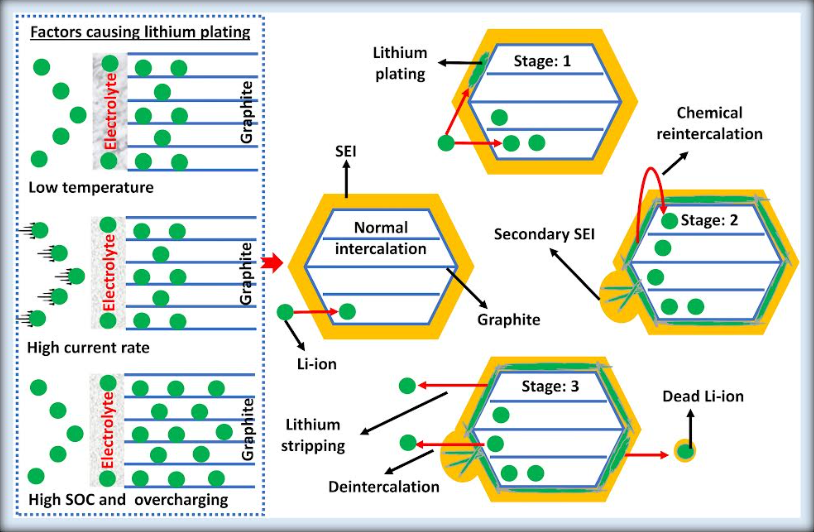
“Conventional charging systems often use fixed charging patterns that do not adapt to changing battery conditions. But batteries are not static systems. Their behaviour changes with temperature, operating history, and age,” said Prof Pallavi Bharadwaj, Assistant Professor at the Department of Electrical Engineering and the Principal Investigator of Smart Power Electronics Laboratory.
To address the challenge, the team developed an optimised, five-step adaptive Multi-Step Constant Current (MSCC) charging strategy. Unlike conventional, rigid charging profiles that assume a battery is permanently new and operating at room temperature, this new algorithm adjusts its step thresholds at the beginning of every charging process based on the battery’s real-time State of Age (SOA) and Battery Ambient Temperature (BAT). The proposed framework acts as an intelligent supervisor. It identifies the exact, shifting voltage threshold where lithium plating is about to trigger under any given weather or health condition, and instantly commands the charger to step down to a safer current level to prevent lithium plating and potential physical damage.
To identify the onset of lithium plating, the researchers developed a monitoring approach based on changes in the battery’s internal impedance. Using Rest-Interrupted Constant Current (RICC) testing, the charging current was briefly paused at regular intervals to measure subtle impedance variations associated with plating onset. The team then used the Taguchi method, a statistical optimisation technique widely used in engineering design, to determine the optimal charging currents for the multi-step charging profile.
The proposed charging strategy was experimentally validated using commercial Panasonic NCR18650B nickel-cobalt-aluminium (NCA) lithium-ion cells across a wide plating-prone operating temperature range, from -5°C to 25°C, and battery ageing conditions ranging from fresh cells to 15% degraded cells.
According to the study, the proposed charging strategy improved charge capacity utilisation by 10.65% and charging efficiency by 0.55% compared to a conventional plating-aware charging approach. The researchers also observed that the system effectively suppressed lithium plating across a broad range of temperatures and battery ageing conditions. “This strategy shifts part of the safety burden from hardware-intensive protection systems to an intelligent software framework, which can be integrated within the battery management system,” said Mr Sinha.
The practical value of this research is directly tied to major shifts in public policy and automotive infrastructure, both in India and across the globe. The country’s electric mobility ambitions, under initiatives such as Faster Adoption and Manufacturing of Electric Vehicles (FAME), the National Programme on Advanced Chemistry Cell (ACC) Battery Storage, and the expansion of public charging infrastructure, will increasingly require battery systems that can withstand diverse climatic conditions and long-term operational stress. Adaptive charging technologies could help improve battery durability, reduce lifecycle costs for EV users, and strengthen the sustainability of India’s emerging battery ecosystem.
Globally, the research also connects to growing efforts to improve the durability and sustainability of nickel-rich lithium-ion batteries, which continue to power many long-range electric vehicles because of their high energy density.
As EV manufacturers push toward shorter charging times and longer battery warranties, managing the trade-off between charging speed and battery health is becoming increasingly important. The IITGN study suggests that future advances in electric mobility may rely on smarter charging systems capable of adapting to battery operating conditions in real time.