
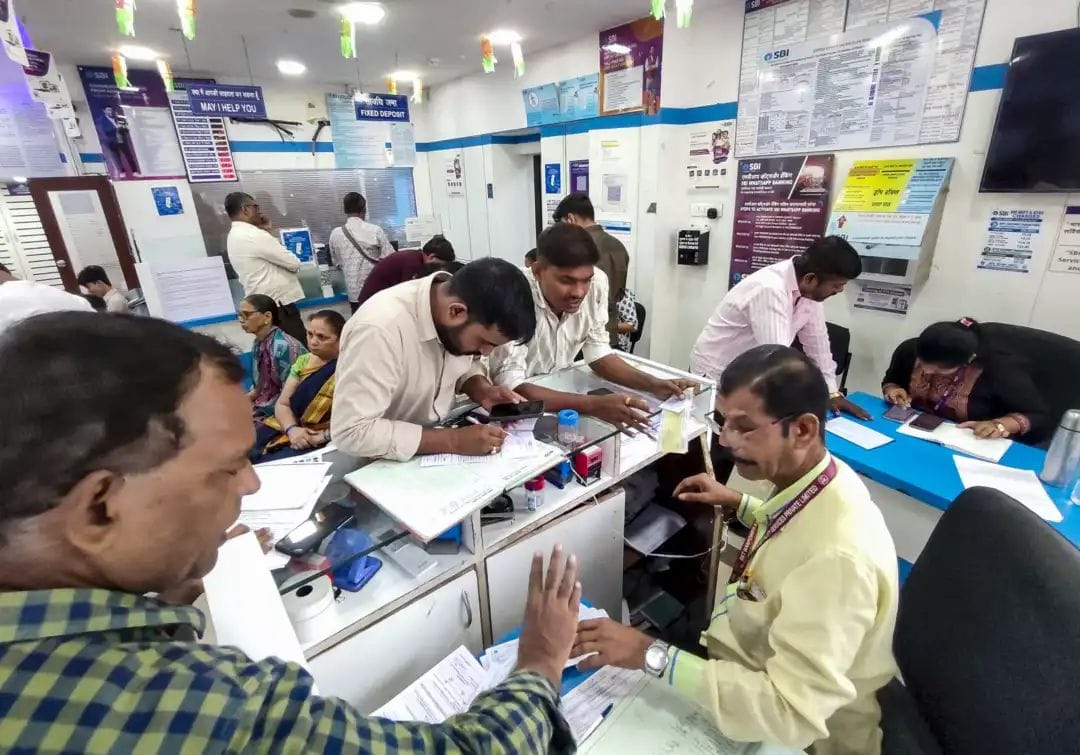
Banking services such as cheque clearance, cash deposits and withdrawals are likely to be affected for three days from Monday as bank unions begin a nationwide strike over their demand for a five-day working week and other pending issues.

The strike is expected to mainly affect public sector banks, old-generation private banks and regional rural banks. However, digital banking services, ATMs, UPI and other online channels are expected to continue functioning.
Branches of new-generation private sector banks, including ICICI Bank, HDFC Bank and Axis Bank, will remain open during the strike.
The three-day strike comes after a one-day nationwide strike observed by bank unions on September 11.
Banks advise customers to plan transactions
Most public sector banks and other financial institutions have issued advisories asking customers to complete important transactions before the strike.
The State Bank of India (SBI) said it would make efforts to provide essential banking services at branches and offices, but some services could be affected during the strike.
SBI advised customers to complete essential transactions in advance and use ATMs, cash deposit machines, YONO, internet banking, mobile banking and UPI wherever possible.
Unions threaten indefinite strike
The strike has been called by the United Forum of Bank Unions (UFBU), an umbrella organisation representing seven bank employees’ and officers’ unions.
The unions have also warned of an indefinite strike from October 26, 2026, if their demands are not addressed.
The demand for a five-day banking week has remained unresolved for several years. Union leaders said the government did not give any commitment on the issue during recent conciliation meetings before the Chief Labour Commissioner.
Rupam Roy, general secretary of the All India Bank Officers’ Confederation (AIBOC), said the unions were compelled to intensify their agitation due to the government’s and management’s position on their demands.
What are the unions demanding?
Apart from a five-day working week, bank unions are seeking:
- Improvements and updates to pension benefits
- A uniform dearness allowance formula for all pensioners
- An option for employees covered under the National Pension System (NPS) to switch to the Old Pension Scheme (OPS)
Union leaders have pointed out that a five-day working week is already followed by several government and financial institutions, including the Reserve Bank of India, LIC, GIC and NABARD. They have also cited the five-day working schedule followed by the stock, money and foreign exchange markets.
Finance Ministry appeals against strike
The Finance Ministry has appealed to bank employees to avoid strikes and resolve their remaining demands through dialogue.
The ministry said most concerns raised by the unions had been substantially addressed, while the remaining issues were still being examined. It also urged employees to ensure that banking services remain uninterrupted.
One of the unions’ key demands, withdrawal of the performance-linked incentive (PLI) scheme, was put in abeyance earlier this month following discussions with the government.
Despite this development and continued talks, bank unions went ahead with a one-day nationwide strike on September 11. The latest three-day strike is expected to cause further disruption to branch-level banking services.