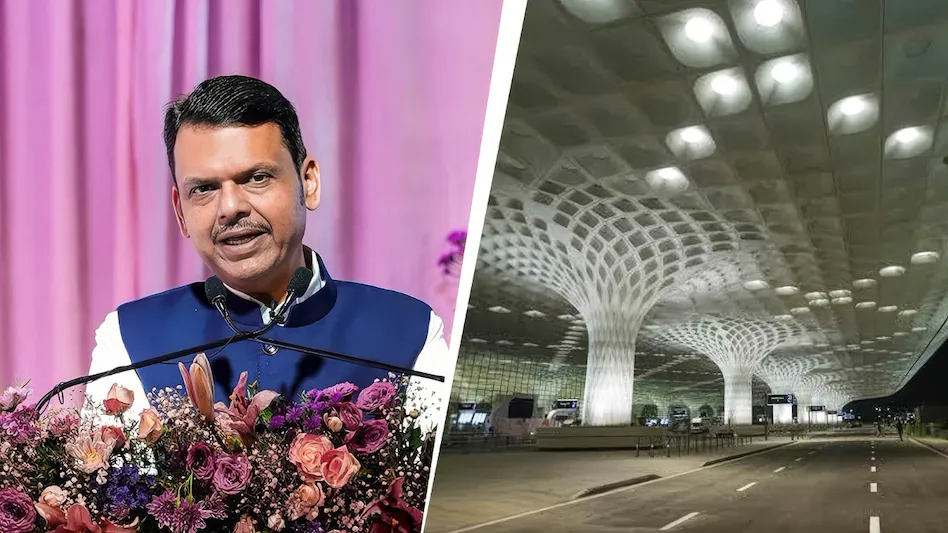
Maharashtra Chief Minister Devendra Fadnavis has opposed the proposed shifting of international flights from Mumbai’s Chhatrapati Shivaji Maharaj International Airport (CSMIA) to Navi Mumbai International Airport (NMIA), suggesting an alternative plan for the redevelopment of Terminal 1.

In a letter to the Union Civil Aviation Ministry, Fadnavis proposed a phased redevelopment strategy that would allow the existing terminal to remain operational while its replacement is constructed. The proposal aims to prevent flight cancellations or disruptions during the construction period.
“The idea is to have simultaneous development so that there is no need to transfer or cancel flights,” a senior official from the Chief Minister’s Office (CMO) told PTI.
Under the suggested plan, Terminal 1B would be developed first, following which operations from Terminal 1A would be shifted to the newly constructed facility. Terminal 1A would then be demolished and rebuilt.
The approach would allow the airport to undertake redevelopment in phases rather than shutting down the entire existing terminal before beginning construction of its replacement.
Terminal 1, which was commissioned in 1964, is being redeveloped primarily to address structural and safety concerns highlighted in audits conducted by Structwel in 2017 and the Indian Institute of Technology Bombay (IIT-Bombay) in 2024.
Airlines Raise Concerns Over Proposed Flight Transfers
The proposed relocation of international flights to Navi Mumbai has faced opposition from several airlines, particularly foreign carriers, which have expressed concerns over the transition arrangements and connectivity infrastructure at the new airport.
Mumbai International Airport Ltd (MIAL), the operator of CSMIA, had initially planned to shift flights serving 14 international destinations, including Bahrain, Doha, Jeddah, Kathmandu, Kuwait, Muscat and Riyadh, to NMIA from October 25. However, following objections from several foreign airlines, the proposed transition was postponed to March 2027.
MIAL is considering relocating or temporarily suspending up to 260 international departures to accommodate domestic operations displaced by the shifting of flights from Terminal 1.
Located in Navi Mumbai, the new international airport is expected to ease congestion at the existing Mumbai airport. However, concerns have been raised about road connectivity and supporting infrastructure, particularly the potential impact on passenger travel times.
Meanwhile, Air India, Air India Express, IndiGo and Akasa Air, along with Adani Airport Holdings, have announced plans to shift their international operations to NMIA in phases over the coming months.
Mumbai Airport’s Terminal 2 May See 33% Cut in International Operations
In a separate development, Mumbai International Airport Ltd has informed airlines about its proposal to reduce international operations at Terminal 2 by nearly one-third from the Summer 2027 schedule, which begins towards the end of March.
The move is intended to accommodate five million passengers per annum (MPPA) of domestic traffic displaced during the first phase of Terminal 1’s demolition.
The existing Terminal 1, which has a passenger-handling capacity of 15 million passengers annually, is scheduled to be completely demolished by March 2028, with reconstruction planned thereafter. The redevelopment is expected to increase its capacity to 20 million passengers per annum.
The new terminal will also feature improvements in passenger processing, security screening and other airport infrastructure.
However, airline representatives have warned that the complete closure of Terminal 1 could leave Mumbai airport facing a significant capacity shortage for three years or more.
MIAL had initially planned to begin the partial relocation of international operations from October 25, 2026, but subsequently deferred the transition to March 2027 following concerns raised by foreign airlines.
Earlier, representatives from more than 35 airlines held discussions with Mumbai airport officials regarding the proposed transition. Sources said the meeting involved constructive discussions, with MIAL presenting detailed schedules for the redevelopment of Terminal 1.
The redeveloped Terminal 1 is targeted to become operational by March 2029, while the broader terminal replacement timeline outlined in the proposal extends to December 2030.