

Researchers at the Indian Institute of Technology Gandhinagar (IITGN) and the Regional Centre for Biotechnology, Faridabad, have developed and tested a new class of fluorescent probes that enable scientists to visualise xylem, the specialised tissue responsible for transporting water and minerals through plants.

The work, published in Plant and Cell Physiology, introduces a faster, more specific and sensitive staining method than conventional dyes, creating avenues to strengthen research on plant development, vascular biology, and crop resilience.
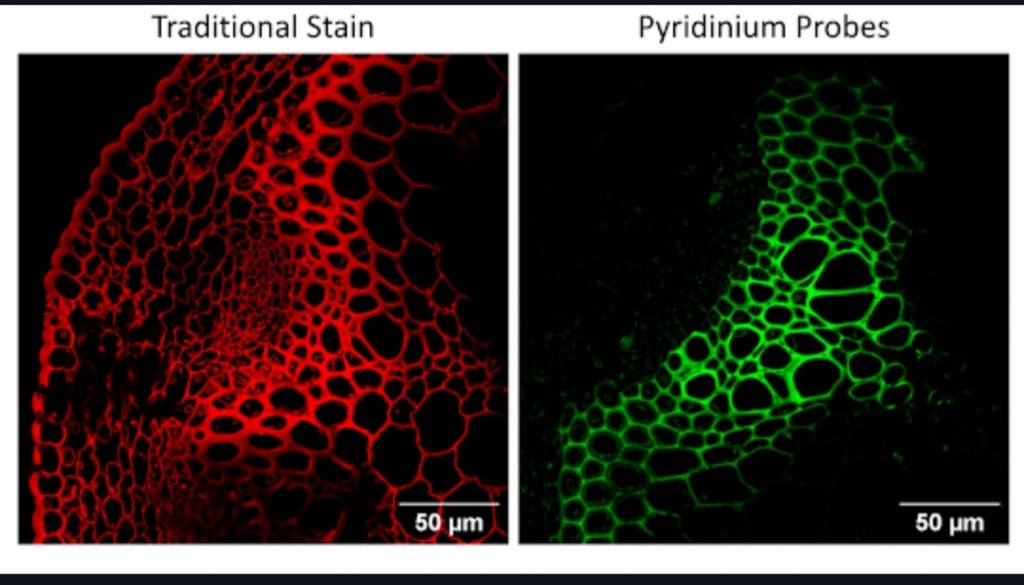
Every vascular plant runs on two pipe networks. Phloem carries sugars from leaves outward. Xylem carries water and dissolved minerals upward from the roots, sometimes to remarkable heights. Alongside supporting the plant’s structure, this vascular tissue determines how efficiently a plant copes with drought, heat and other environmental stresses.
To study the xylem, you slice plant tissue thin and stain it with standard dyes, such as propidium iodide, berberine, basic fuchsin, or rhodamine.
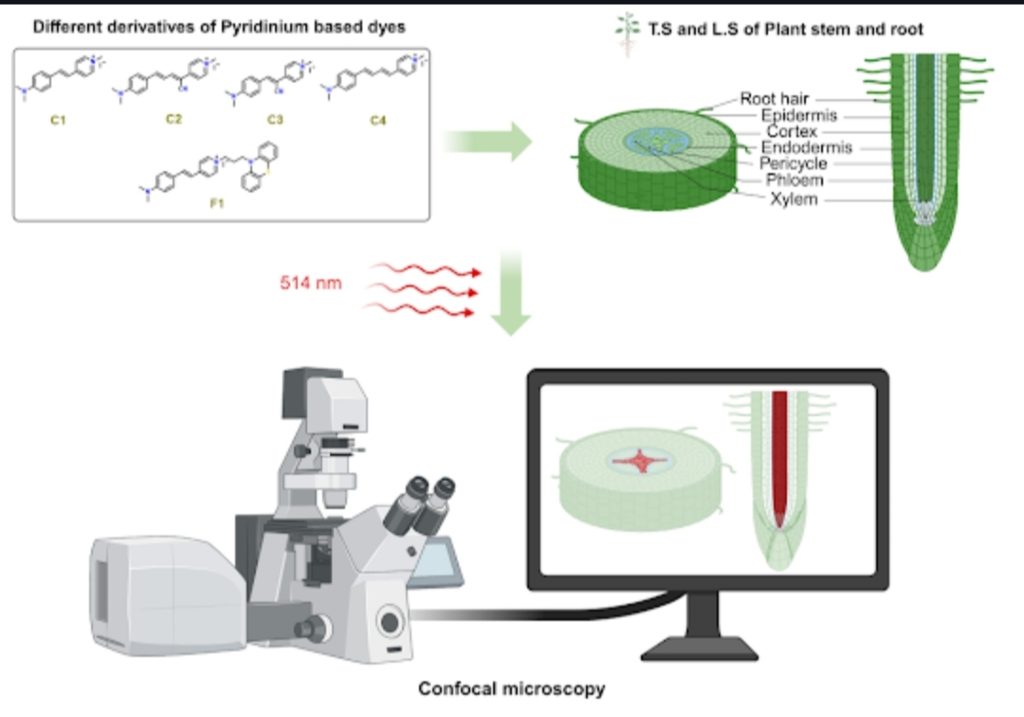
This is an established technology, with some of the dyes in routine use characterised in the 1960s. The stains bind broadly to charged or aromatic compounds in plant cell walls.
“The main issue here is that xylem is not the only tissue made of charged, aromatic material,” explained Dr Subramanian Sankaranarayanan, an Assistant Professor at IITGN’s Department of Biological Sciences and Engineering.
“The practical consequence is that a plant biologist looking at a stained section is often looking at xylem, phloem and cambium all lit up together, and has to reason about which glow belongs to which.” Researchers compensate by dual staining with different dyes, which introduces its own confusion and dilemma, or by cranking up laser power, which bleaches the sample as they watch.
In 2023, a research team from the Indian Institute of Technology Gandhinagar (IITGN) reported fluorescent molecules built to slip inside mitochondria in mammalian cells. The probes were designed to detect a reactive chemical linked to inflammation, thereby aiding biomedical imaging. They had nothing to do with plants.
These molecules use an architecture chemists call donor–π–acceptor. One end pushes electrons, the other pulls, and a bridge connects them. Shine light on it and charge shifts internally. How brightly it glows, and at what colour, depends on how greasy, rigid or polar its surroundings are. In animal cells, that sensitivity made them chemical sensors. In plant tissue, it made them selective.
The insight was that a molecule sensitive to its chemical environment could, in principle, distinguish between environments. For example, the interior of a lignified xylem wall is chemically very different from that of a phloem cell. “This crossover was leveraged by us,” said Prof Sriram Kanvah, Professor at the Department of Chemistry, IITGN, and the Principal Investigator of the team that created these fluorescent probes.
The team synthesised the positively charged pyridinium dyes, four of which were synthesised in the aforementioned 2023 study (C1-C4). Interestingly, two of them, C1 and C3, did something the standard reagents do not. They stained the xylem, producing sharper, more selective images, and left everything else alone. The researchers evaluated the probes in Arabidopsis thaliana, the small flowering plant that serves as the world’s most widely used model organism in plant biology. To determine whether the probes could work beyond laboratory models, they also examined tissues from Nicotiana benthamiana, a widely used tobacco relative, and Allium fistulosum, commonly known as Welsh onion.
The team found that the improvement was not limited to image quality. The probes generated strong fluorescence signals at concentrations much lower than those required for propidium iodide, one of the most commonly used dyes for plant tissue imaging.
While propidium iodide needed a concentration of 375 micromolar to produce clear images, the new dyes achieved the same at just 25 micromolar, using about 15 times less dye. It also performed superiorly in terms of specificity compared to other known dyes used for xylem staining. Because they work at lower concentrations and require less laser power, the new probes can reduce photobleaching, where fluorescent dyes gradually lose their brightness during imaging. Such lower dye concentrations can also reduce unnecessary background staining.
“The project brought together molecular design, spectroscopy and plant biology to develop probes with properties tailored for biological imaging. It was particularly exciting to see molecules originally developed for a different application perform so effectively in plant vascular tissues, opening up new possibilities for designing future imaging agents,” said Prof Kanvah.
The researchers did not stop at healthy plants. They also tested the probes in the Arabidopsis eskimo1 mutant, which develops collapsed xylem vessels due to defects in cell wall formation. Visualising these structural abnormalities is often challenging with conventional stains. Here again, C1 and C3 provided a clearer definition of the damaged xylem vessels than existing dyes.
“Rather than addressing a biological question directly, this work focuses on improving the experimental tools available to plant scientists,” said Prof Sankaranarayanan. “By increasing the sensitivity and specificity of xylem staining, we hope these probes will make it easier to investigate plant development, vascular defects, and responses to environmental conditions.”
The authors note that further work is needed to determine exactly how these dyes bind to the cell wall and to adapt them for use in living tissue. Overcoming these challenges would let researchers move from still images of plant tissue to watching as water-conducting vessels form and respond in real time.
List of authors: Hemal Bhalla, Simran Gaith, Deeksha Rajput, Bhagwat Prasad Dewangan, Prashant Anupama-Mohan Pawar, Sriram Kanvah, Subramanian Sankaranarayanan
Article Title: Pyridinium Derivatives as Novel Fluorescent Probes for Xylem Staining in Plant Tissue
journal Details: Plant and Cell Physiology
DOI: https://doi.org/10.1093/pcp/pcag084