With Diwali approaching, the issue of air pollution caused by firecrackers has once again come into focus, particularly in Delhi and the National Capital Region (NCR), where air quality often deteriorates during the festive season.

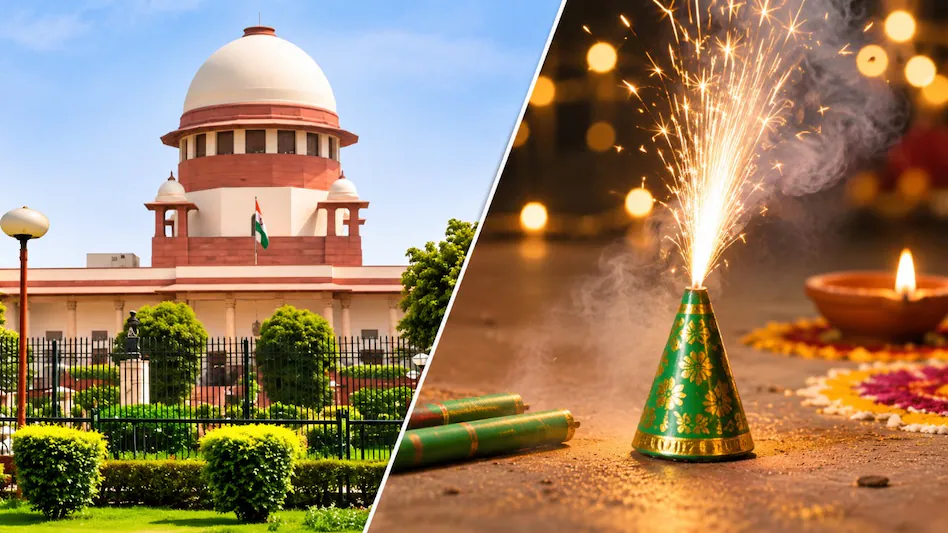
In a temporary relaxation, the Supreme Court has permitted the use of certified green firecrackers in Delhi-NCR on November 7 and 8, 2026, subject to strict conditions. The permission is limited to specific time slots, and the complete ban on firecrackers will be restored from November 9.
A bench of Justices M.M. Sundresh and Prasanna B. Varale issued the directions on October 29. The court said the decision was intended to regulate the sale and use of approved firecrackers while preventing conventional and unauthorised products from being sold as green crackers.
Here is a look at what green firecrackers are, how they differ from conventional ones and the restrictions imposed by the Supreme Court.
Supreme Court permits green crackers for two days
According to the Supreme Court’s directions, people in Delhi-NCR can burst certified green firecrackers only during the following hours:
- November 7, 2026: 6 am to 7 am and 8 pm to 10 pm
- November 8, 2026: 6 am to 7 am and 8 pm to 10 pm
The permission applies only to approved green firecrackers. The complete ban on the manufacture, sale and use of firecrackers will return from November 9.
The court observed that despite earlier restrictions, conventional firecrackers continued to be sold illegally under the label of green crackers. It therefore favoured a regulated approach with stricter monitoring and enforcement.
What are green firecrackers and who developed them?
Green firecrackers are specially formulated fireworks designed to reduce emissions compared with conventional firecrackers. They have been developed by the Council of Scientific and Industrial Research–National Environmental Engineering Research Institute (CSIR-NEERI).
These products use modified chemical formulations and reduced quantities of certain raw materials to lower the release of particulate matter and harmful gases during combustion.
According to CSIR-NEERI, green crackers are required to meet specified emission-reduction standards. These include at least a 30% reduction in particulate matter or a combination of particulate matter and gaseous emission reductions compared with conventional formulations.
However, green crackers are not pollution-free. They are designed to reduce emissions and must meet the prescribed certification standards.
How are green firecrackers different from conventional crackers?
Conventional firecrackers release particulate matter, including PM2.5 and PM10, along with gases such as sulphur dioxide and nitrogen oxides. They may also release metals and other harmful substances, contributing to air pollution.
Green firecrackers use modified formulations to reduce these emissions. Certain additives and alternative chemical compositions are used to improve combustion and suppress the release of dust and smoke.
Their key features include:
- Reduced particulate emissions compared with conventional firecrackers.
- Modified chemical formulations to limit the release of certain pollutants.
- Lower emissions of selected harmful gases.
- Controlled noise levels and compliance with prescribed standards.
The extent of emission reduction depends on the product and its formulation. Therefore, only firecrackers certified by CSIR-NEERI and licensed by the Petroleum and Explosives Safety Organisation (PESO) are permitted under the Supreme Court’s order.
Strict rules for manufacturers and traders
The Supreme Court has laid down specific conditions for the manufacture, storage and sale of green firecrackers in Delhi-NCR.
- Only manufacturers holding valid CSIR-NEERI certification and PESO licences can manufacture approved green crackers listed on the CSIR-NEERI website between November 2 and 6, 2026.
- All green firecracker boxes must be completely sealed to prevent conventional or unauthorised products from being mixed with them.
- The manufacture and sale of firecrackers joined in series, commonly known as ‘ladis’, and garlands are prohibited.
- Firecrackers containing barium and products not approved by CSIR-NEERI are not permitted.
- Only licensed traders can sell approved green crackers at locations designated by the district administration.
- Manufacturers and traders will have to furnish a monetary security deposit. The amount will be decided by the authorities and can be forfeited in case of violations.
- Traders found violating the conditions may face cancellation of their licences and registrations.
The court has also prohibited the sale and purchase of firecrackers through online platforms and e-commerce websites.
How can consumers identify genuine green crackers?
To prevent conventional firecrackers from being sold as green products, the Supreme Court has made product-specific QR codes mandatory.
Every box must carry a QR code that, when scanned, provides details such as:
- Manufacturer’s name
- CSIR-NEERI registration
- PESO or district magistrate licence details
- Product formulation
- Testing certificate
The QR code must be specific to the product and batch and cannot be transferred to another product.
Consumers have also been prohibited from bringing firecrackers into Delhi-NCR from outside the region. The authorities have been directed to check vehicles entering the area to prevent the transportation of conventional and illegal firecrackers.
300-metre no-cracker zones around hospitals and educational institutions
The Supreme Court has prohibited the bursting of firecrackers within a 300-metre radius of the following locations:
- Hospitals and nursing homes
- Primary and district health centres
- Old-age homes
- Educational institutions
- Notified silence zones
These areas will be declared no-cracker zones, marked on the ground and publicised by the authorities.
Police and district administration teams will conduct inspections at designated sales locations, verify QR codes and confiscate unauthorised or conventional firecrackers. Prosecution will also be initiated against those violating the court’s directions.
Air quality monitoring and reporting after Diwali
The Supreme Court has directed the Central Pollution Control Board (CPCB), in coordination with State Pollution Control Boards, to monitor air quality across Delhi-NCR and prepare reports covering three periods:
- Pre-Diwali: November 2 to 6
- Diwali: November 7 and 8
- Post-Diwali: November 9 to 30
Authorities will also collect sand and water samples for comparative analysis. Air quality monitoring stations reported to be non-functional will be inspected and repaired wherever necessary.
The court has further directed authorities to collect information on hospital admissions and reported deaths linked to pollution following the festival.
The governments and concerned authorities in Delhi-NCR will have to submit compliance reports and affidavits to the court by December 14, 2026. Officials responsible for failing to implement the directions may face contempt action.
The temporary relaxation is aimed at allowing limited festive celebrations while keeping pollution and public health concerns in focus. However, the court has made it clear that the restrictions must be strictly enforced and the complete ban will return from November 9.