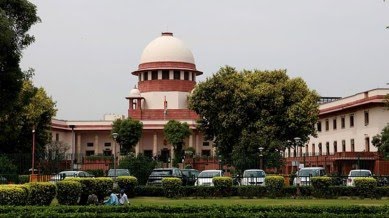
The Supreme Court has declined an urgent hearing on a petition seeking restrictions on steep airfares charged by private airlines during the Diwali festive season. The petition alleged that ticket prices had increased by as much as 700% compared to normal fares and sought a cap on airline charges.

Responding to the request for an early hearing, Justice Vikram Nath remarked, “Do not travel by plane,” before asking for the next matter to be taken up by the bench.
The petition has been filed as a Public Interest Litigation (PIL), alleging that private airlines arbitrarily increase fares during festivals, holidays and emergencies. It argued that air travel has become an essential service and that excessive and unpredictable fare hikes violate Article 14 of the Constitution, which guarantees equality before the law.
Plea seeks regulation of airline fares
The petitioner has sought government intervention to prevent airlines from charging what it described as arbitrary and exorbitant fares during periods of high demand.
In October, the Centre informed the Supreme Court that new rules to regulate airfares under the Indian Aircraft Act, 2024, had received administrative approval and were likely to be notified within two weeks.
The court had asked the government to place the proposed rules before it ahead of the next hearing, scheduled for November 16. However, the petitioner’s request for an earlier hearing was not accepted by Justice Vikram Nath.
Rising fuel costs add to pressure on airfares
Rising aviation fuel costs have also emerged as a concern for the airline industry. Volatility in global crude oil prices, amid tensions involving the US, Israel and Iran and disruptions around the Strait of Hormuz, has added to concerns over airline operating expenses.
Aviation turbine fuel (ATF) accounts for a significant share of airline operating costs, making carriers particularly vulnerable to fluctuations in fuel prices.
IndiGo CEO flags possibility of further fare hikes
IndiGo CEO Willie Walsh has also warned that rising ATF prices could put further pressure on airfares. He said the airline was attempting to absorb as much of the additional cost as possible, but increasing operating expenses were affecting the industry’s financial position.
Fuel accounts for around 32% of airlines’ total operating costs. Higher airport charges and taxes have added to the financial burden, with Walsh also calling for a reduction in these expenses.
Meanwhile, the Centre’s proposed regulatory framework is expected to give the government powers to intervene in airline pricing during exceptional circumstances and in the public interest.