
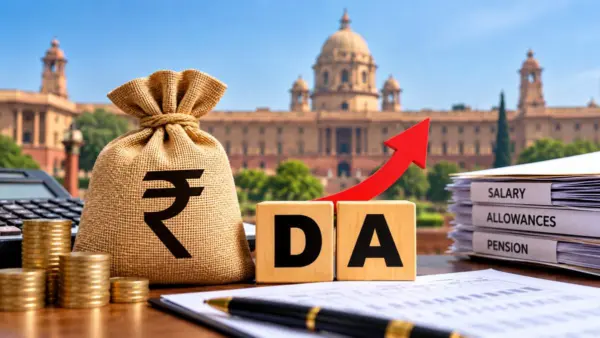
The Union Cabinet has approved a 3 percentage-point increase in Dearness Allowance (DA) for central government employees, raising it from 60% to 63% of basic pay with effect from July 1, 2026. The decision also includes a corresponding increase in Dearness Relief (DR) for pensioners, providing additional financial support amid rising living costs.

The revision is expected to benefit approximately 48 lakh central government employees and 68 lakh pensioners. According to the government, the combined annual impact of the decision on the exchequer will be Rs 10,016 crore.
The latest increase follows the established formula based on the recommendations of the Seventh Central Pay Commission. In the previous revision, DA was raised to 60% from January 1, 2026. The allowance is generally revised twice a year, in January and July, to help employees and pensioners cope with inflation.
How Much Will Employees Gain?
The additional amount will depend on an employee’s basic salary, as DA is calculated as a percentage of basic pay. For example, an employee drawing a basic salary of Rs 50,000 will see the DA component increase from Rs 30,000 to Rs 31,500 per month, resulting in an additional Rs 1,500 monthly.
Pensioners will receive a corresponding benefit through DR, calculated on their basic pension. The actual increase will therefore vary depending on each pensioner’s pension amount.
Revised DA Rates Under Older Pay Commissions
The Cabinet decision also covers employees and pensioners whose allowances are governed by older pay commission structures.
Under the Sixth Central Pay Commission framework, DA and DR rates will rise by seven percentage points, from 262% to 269%. Under the Fifth Central Pay Commission framework, the rates will increase by 14 percentage points, from 483% to 497%. Both revisions will take effect from July 1, 2026.
What Is the Status of the 8th Pay Commission?
The government announced the formation of the Eighth Central Pay Commission on November 3, 2025, appointing former Supreme Court judge Justice Ranjana Prakash Desai as its chairperson.
The commission has been given 18 months to submit its recommendations, placing the expected deadline around May 2027. It will examine salaries, allowances, pensions and other service benefits for central government employees and pensioners.
However, the new pay structure will not come into effect automatically once the commission submits its report. The government must examine the recommendations and decide on their acceptance and implementation. The proposed fitment factor, revised salary scales and implementation timeline have not yet been finalised.
Will DA Be Merged With Basic Pay?
Employee unions have been demanding that DA be merged with basic pay to provide additional relief while employees await the next pay revision. Such a merger could also influence certain salary-linked benefits and retirement calculations.
A similar move was made in 2004, when 50% of DA was merged with basic pay as Dearness Pay under the Fifth Pay Commission framework. However, there is no automatic provision requiring such a merger whenever DA reaches a particular level.
In December 2025, the Finance Ministry informed Parliament that the government was not considering a proposal to merge existing DA with basic pay. Therefore, the latest increase to 63% does not indicate that a merger is imminent.
For now, the approved revision will provide additional inflation-linked relief to serving employees and pensioners under the existing pay structure. Any broader changes to salaries, pensions and allowances will depend on the Eighth Pay Commission’s recommendations and subsequent government decisions.