
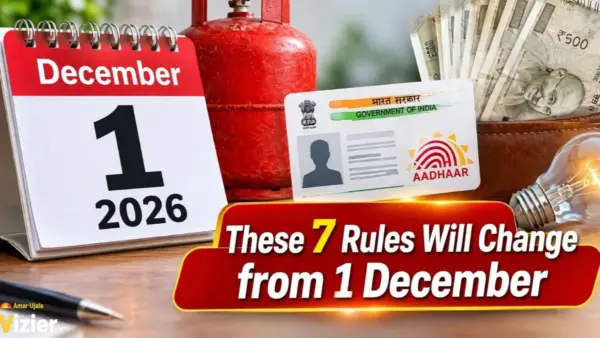
As December approaches, several financial and regulatory changes are set to take effect, potentially affecting consumers, investors, pensioners and borrowers. These include revised charges for SBI credit card users, new margin requirements for commodity traders, simplified KYC rules for overseas investors and a deadline for pensioners to submit their annual life certificates.

The month will also bring the usual review of LPG cylinder prices and the Reserve Bank of India’s (RBI) monetary policy announcement. Here are seven important updates to keep in mind before December begins.
1. SBI Credit Card Users to Face New Charges on Select Transactions
SBI Card will introduce additional charges on certain high-value transportation and fuel transactions from December 1, 2026.
- A 1% fee will apply to individual transportation transactions exceeding ₹30,000.
- The charge will be calculated on each eligible transaction, not on the cardholder’s total monthly transportation spending.
For instance, a transportation payment of ₹35,000 will attract an additional fee of ₹350, excluding applicable taxes.
There will also be a change in the fee structure for fuel purchases. If the total eligible fuel transactions made during a billing cycle exceed ₹50,000, a 1% fee will be charged on the entire fuel expenditure for that cycle.
Cardholders who regularly make high-value fuel or transportation payments should check the revised charges before using their cards. Mint+1
2. SEBI Revises Margin Rules for Commodity Traders
The Securities and Exchange Board of India (SEBI) is introducing revised margin requirements for commodity derivatives trading from December 1, 2026.
Under the revised framework, minimum initial margins will be linked to the volatility of commodities. The requirements will be:
- Low-volatility commodities: 6%
- Medium-volatility commodities: 8%
- High-volatility commodities: 10%
The minimum Margin Period of Risk (MPOR) will be two days for low- and medium-volatility commodities and three days for high-volatility commodities.
The revised requirements apply to both agricultural and non-agricultural commodities. Traders may therefore need to maintain different levels of funds depending on the volatility category of the commodity they trade. Securities and Exchange Board of India+1
3. SEBI to Simplify KYC for Eligible Overseas Investors
SEBI is easing the Know Your Customer (KYC) process for eligible investors residing outside India from December 3, 2026.
The revised framework covers Non-Resident Indians (NRIs), Overseas Citizens of India (OCIs) and eligible foreign nationals residing in countries that comply with Financial Action Task Force (FATF) standards.
Under the new rules, eligible investors will be able to complete their KYC and re-KYC remotely through SEBI-registered intermediaries. They will no longer need to travel to India solely for physical verification, subject to the prescribed digital documentation and video-verification requirements.
The move is expected to make it easier for eligible overseas investors to access the Indian securities market. NSDL+2
4. Aadhaar Email Address Updates Available Free of Charge Until December 31
Aadhaar holders can update their registered email addresses through the Aadhaar mobile application without paying the usual ₹75 fee.
The Unique Identification Authority of India (UIDAI) introduced the fee waiver on July 1, 2026, for a period of six months. The facility will remain available until December 31, 2026.
Those planning to update their Aadhaar-linked email addresses can use the free facility before the deadline. UIDAI+1
5. Pensioners Must Submit Life Certificates by November 30
Central government pensioners need to submit their annual life certificates by November 30 to ensure the uninterrupted disbursement of their pensions.
A life certificate, also known as a Jeevan Pramaan, confirms that a pensioner is alive and eligible to receive pension benefits.
Pensioners can submit the certificate digitally through the Jeevan Pramaan service and do not necessarily need to visit a bank or government office in person.
Failure to submit the certificate within the prescribed period may lead to delays or interruptions in pension payments.
6. LPG Cylinder Prices May Be Revised on December 1
Oil marketing companies review LPG cylinder prices on the first day of every month. Accordingly, consumers will be watching for the revised domestic and commercial LPG rates on December 1, 2026.
Any increase or reduction in prices could affect household budgets as well as operating costs for restaurants, hotels and other businesses.
The revised rates, if any, will be known once the oil marketing companies announce their monthly price updates.
7. RBI Monetary Policy Meeting Scheduled for December 2-4
The RBI’s Monetary Policy Committee (MPC) will meet from December 2 to 4, 2026, to review the country’s monetary policy and decide on the policy repo rate.
The repo rate influences borrowing costs across the banking system and can affect interest rates on loans, including home loans and personal loans.
Borrowers and prospective homebuyers will be watching the announcement to see whether the central bank changes the rate or maintains its existing policy stance. Reserve Bank of India+1
Editorial note: The seven updates do not all take effect on December 1. The pension life-certificate deadline is November 30, the KYC changes begin December 3, and the RBI meeting is scheduled for December 2-4. The LPG price revision is not confirmed until the monthly announcement.