
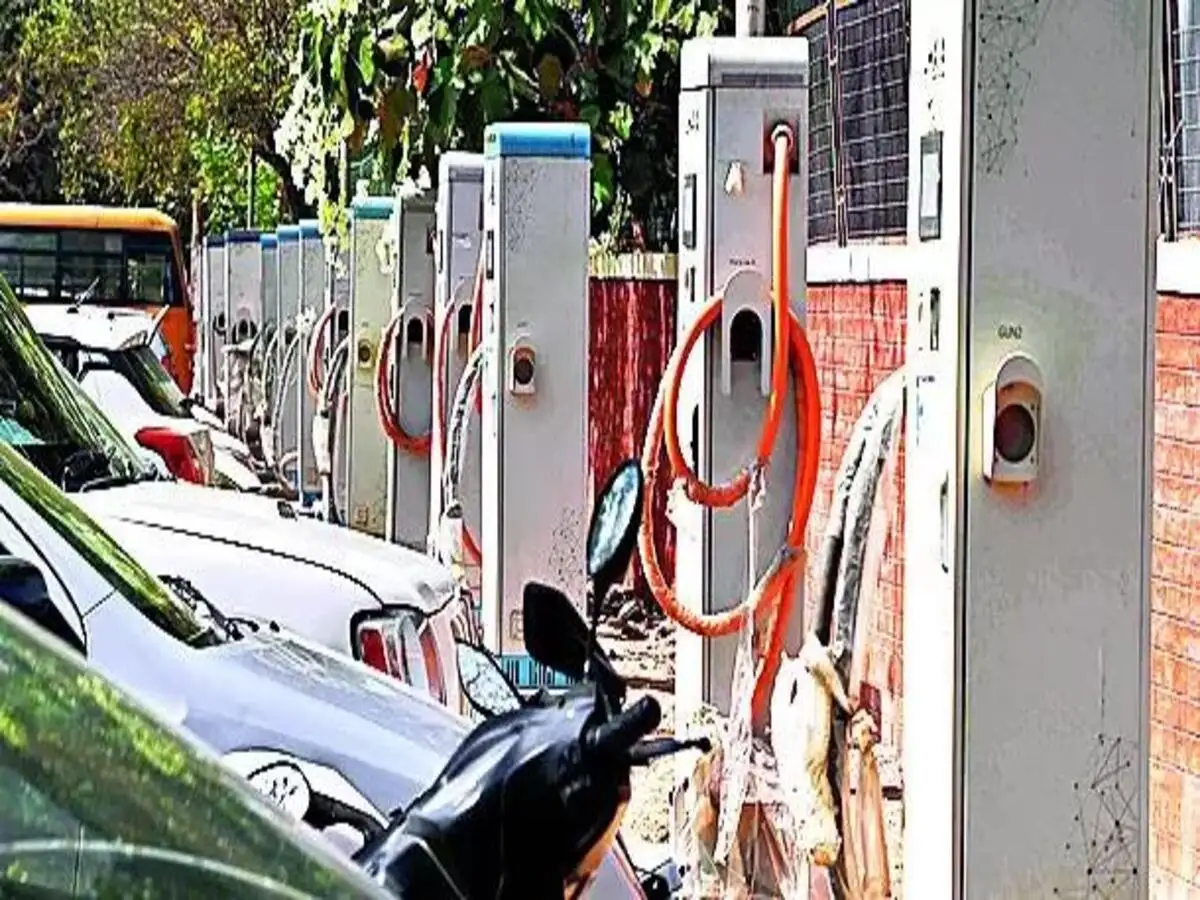
Ahmedabad is preparing to expand its electric vehicle (EV) charging network under a proposed five-year policy extending up to 2030. The city’s EV fleet is projected to reach around 2.49 lakh, compared with an estimated 8.49 lakh across Gujarat. To cater to the anticipated demand, Ahmedabad is expected to require 690 charging points, while the state’s requirement is projected at 3,255.

The proposed plan focuses on expanding charging infrastructure, identifying priority locations, integrating renewable energy and improving the utilisation of existing facilities.
Public Charging Stations to Charge ₹18 Per Unit
Ahmedabad Janmarg Limited (AJL) and the Ahmedabad Municipal Transport Service (AMTS) have proposed charging private EV users ₹18 per unit, plus GST, at their on-route charging stations. Electric buses operated by contractors would be charged ₹16 per unit, plus GST.
The proposal aims to utilise spare capacity at charging facilities developed by the two transport agencies and generate additional revenue without affecting bus operations. However, it does not provide for separate allotment of land or premises to private charging agencies at AJL or AMTS locations.
For wider network expansion, municipal land may be made available through tenders or leases at an upfront cost equivalent to 5% of the applicable Jantri rate, subject to tender conditions and agreement terms. Operators may also be required to share a minimum revenue of ₹1 per unit of electricity consumed.
SG Highway and CG Road Among Priority Charging Zones
A citywide master plan will guide the expansion through a dynamic, GIS-based map tracking operational, under-construction and proposed charging stations. The map will record their locations, capacities and operational status.
Planning will take into account EV adoption, traffic patterns, parking duration, electricity network capacity and areas with inadequate charging facilities.
High-density commercial streets and major mobility corridors, including SG Highway and CG Road, have been identified as proposed priority zones. Measures related to parking, charging access, signage and traffic management may be introduced in these areas.
New residential developments are also proposed to include EV-ready parking spaces, adequate electrical capacity and charging provisions in accordance with building regulations. Existing residential buildings may be equipped with charging infrastructure in phases, subject to technical feasibility and safety requirements.
Battery-Swapping Stations and Dedicated Charging Corridors
The plan also proposes battery-swapping facilities at suitable locations, particularly for electric two-wheelers and three-wheelers used in delivery services and passenger transport.
Dedicated charging corridors and hubs are also proposed for electric buses, logistics vehicles and other heavy-duty EVs.
Solar Power to Be Integrated with Charging Stations
The proposed policy seeks to encourage the use of renewable energy at charging facilities. Operators may procure renewable power through open access wherever permitted, while solar-integrated charging stations and optional battery energy storage systems may be facilitated at suitable locations.
Smart charging systems could encourage vehicles to charge during peak solar-generation hours. Pilot projects involving vehicle-to-grid and vehicle-to-building technologies may also be permitted, subject to regulatory and technical approvals.
Phased Implementation and Monitoring
The expansion is proposed to be carried out in phases, beginning with planning and pilot projects, followed by wider implementation. Periodic reviews will assess EV adoption, charging demand, infrastructure utilisation, grid performance and safety.
A core committee chaired by the municipal commissioner will oversee ground-level implementation and operational management of the proposed policy.