
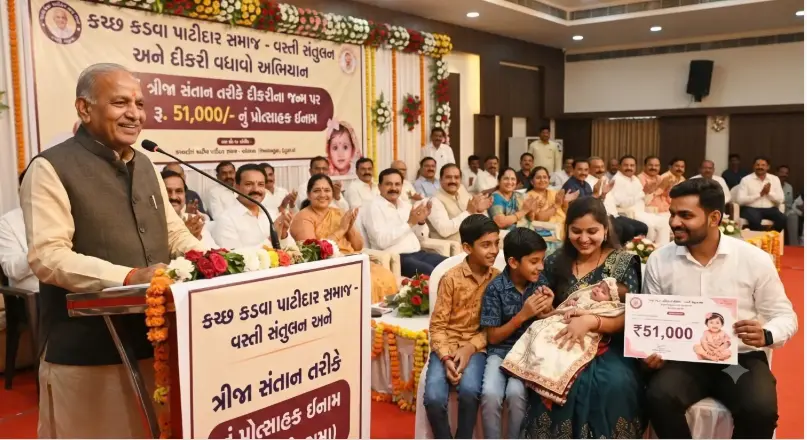
In a bid to address concerns over declining population numbers, the Sabarkantha zone of the Kutch Kadva Patidar Samaj has announced a financial incentive of Rs 51,000 for couples who have a third child and the child is a girl.

The announcement was made during a mass wedding ceremony in Himmatnagar on November 22, following an appeal by R P Patel, president of Vishv Umiyadham, an umbrella organisation of the Kadva Patidar community.
The move follows a similar initiative announced by the Surat (South Gujarat) zone of the Kutch Kadva Patidar Samaj at its annual meeting in Kadodara in September. Under its child encouragement scheme, the community decided to offer a fixed deposit of Rs 50,000 to couples on the birth of their third child, irrespective of gender, with a maximum tenure of 10 years.
Earlier, in January, the Panchal community had also announced a financial incentive of Rs 25,000 for couples having a second child, citing concerns over declining population numbers.
Welcoming the Sabarkantha zone’s decision, Rupalben Patel, president of the women’s wing of Vishv Umiyadham, said the initiative was commendable in view of concerns surrounding the Patidar population. She also stressed that the issue required broader social discussion beyond the community.
“The entire Hindu society, not just the Patidar community, needs to reflect on this,” she said.
R P Patel has been advocating a minimum of three children per family, arguing that the increasing preference for single-child households and smaller families could affect the community’s social strength. He has also called for a wider awareness campaign to encourage families to reconsider their approach to family size.
“It is the clear opinion of the Vishv Umiyadham Foundation that every family must have at least three children,” he said.
The initiatives come amid concerns over Gujarat’s sex ratio at birth. According to the National Family Health Survey-5 (2019-21), Gujarat recorded 955 female births per 1,000 male births, an improvement from 906 in NFHS-4 (2015-16). Meanwhile, the Census 2011 recorded a child sex ratio of 890 girls per 1,000 boys in the state’s 0-6 age group.