
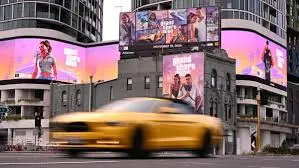
Adam Simmons stayed awake until midnight to get his first glimpse of Grand Theft Auto VI. The 50-year-old director of photography from Wellington, New Zealand, launched the game in his living room as soon as it became available, keeping the volume low so he would not disturb his wife and daughters. By 1 am, he admitted that it was probably time to sleep.

“You really feel like you are in a world,” he told the Associated Press.
Simmons is among millions of players worldwide who have planned their schedules around the highly anticipated release. The launch has generated extraordinary excitement, with people adjusting work and personal commitments to make time for the game.
Kurt Rodgers, network strategy manager at New Zealand internet provider Chorus, described the game’s 212GB download as unprecedented. Meanwhile, Miami-Dade County signed a $3.9 million promotional agreement with Rockstar Games, the studio behind the franchise. HR platform Remote also reported to AFP that leave requests worldwide for November 19 had increased by 32%.
Named after the legal term for stealing a car, Grand Theft Auto began in 1997 as a game centred on vehicle theft and missions for criminal organisations. Since then, the franchise has sold more than 470 million units worldwide.
Its enduring popularity comes from a combination of realistic virtual cities, the freedom to explore without restrictions, social satire and lengthy gaps between releases, which turn every new instalment into a major cultural event.
Cities that mirror the real world
One of the defining features of the GTA franchise is its recreation of real-world locations. Vice City draws inspiration from Miami, Los Santos resembles Los Angeles, while Liberty City takes cues from New York.
For GTA VI, which is set in the fictional US state of Leonida, inspired by Florida, developers reportedly travelled through Miami and the Florida Keys, flew over the Everglades and researched the region’s history and architecture. Rockstar has described Leonida as the largest and most detailed world it has created.
The idea of recreating actual cities in video games is not new. Microsoft’s 1999 racing game Midtown Madness allowed players to drive through a virtual version of Chicago rather than being restricted to conventional racing tracks. Its Cruise mode also gave players the freedom to explore the city without having to complete a race.
Residents of Chicago were invited to test the game’s map, and a report by PC Gamer found that they considered the virtual recreation largely accurate.
For some players, these digital environments also reflect aspects of their own lives. British rapper Bugzy Malone, who hosted a BBC Radio 5 Live podcast about GTA, said in its trailer that the game resonated with his experiences during a difficult period of his life.
“We was living what was going on in that game,” he said.
In Chennai, 35-year-old Fahad Saud, who organised a Vice City-themed night, told AFP that the game offered players an escape from everyday pressures.
“In India, where the day-to-day struggle is so great, GTA gives us the avenue to vent the pressure, to have space and freedom,” he said.
The appeal of complete freedom
The franchise underwent a major transformation with Grand Theft Auto III in 2001, when it introduced players to a fully three-dimensional city environment.
Take-Two Interactive, Rockstar’s parent company, reported in its annual report that GTA III was the best-selling video game in the US across all platforms in the year leading up to October 2002.
The game’s open-world format allowed players to move freely through a virtual city, explore different locations and take up missions at their own pace. This approach became one of the franchise’s biggest attractions.
Researchers have also explored why freedom and choice make video games engaging, although the studies did not specifically examine GTA.
In four studies published in 2006, psychologists Richard Ryan, Scott Rigby and Andrew Przybylski found that players who experienced greater choice and felt capable while playing reported higher enjoyment and a stronger desire to play again.
A 2010 survey involving 385 teenagers, conducted by researchers Wannes Ribbens and Steven Malliet, identified freedom of choice as one of the factors that contributed to a game’s sense of realism.
Similarly, media scholars Geoff King and Tanya Krzywinska argued in 2003 that exploring virtual environments could itself be an enjoyable experience, independent of completing missions or achieving specific objectives.
Players often describe the experience in simpler terms.
“It’s like watching a movie or reading a book, right? It puts you in a different world that you can experience,” 18-year-old Guido Rodriguez told AFP in Miami.
Brayden Whaley, a 23-year-old content creator from Los Angeles, told Reuters that he expected to become completely immersed in the game.
“For me personally, I’m going to enter flow state and what that means is basically I’m going to complete the entire game and not get off of it until I complete it,” he said.
Psychologists use the term ‘flow’ to describe a state of deep concentration and complete absorption in an activity.